Emmett Till Memorial Triptych
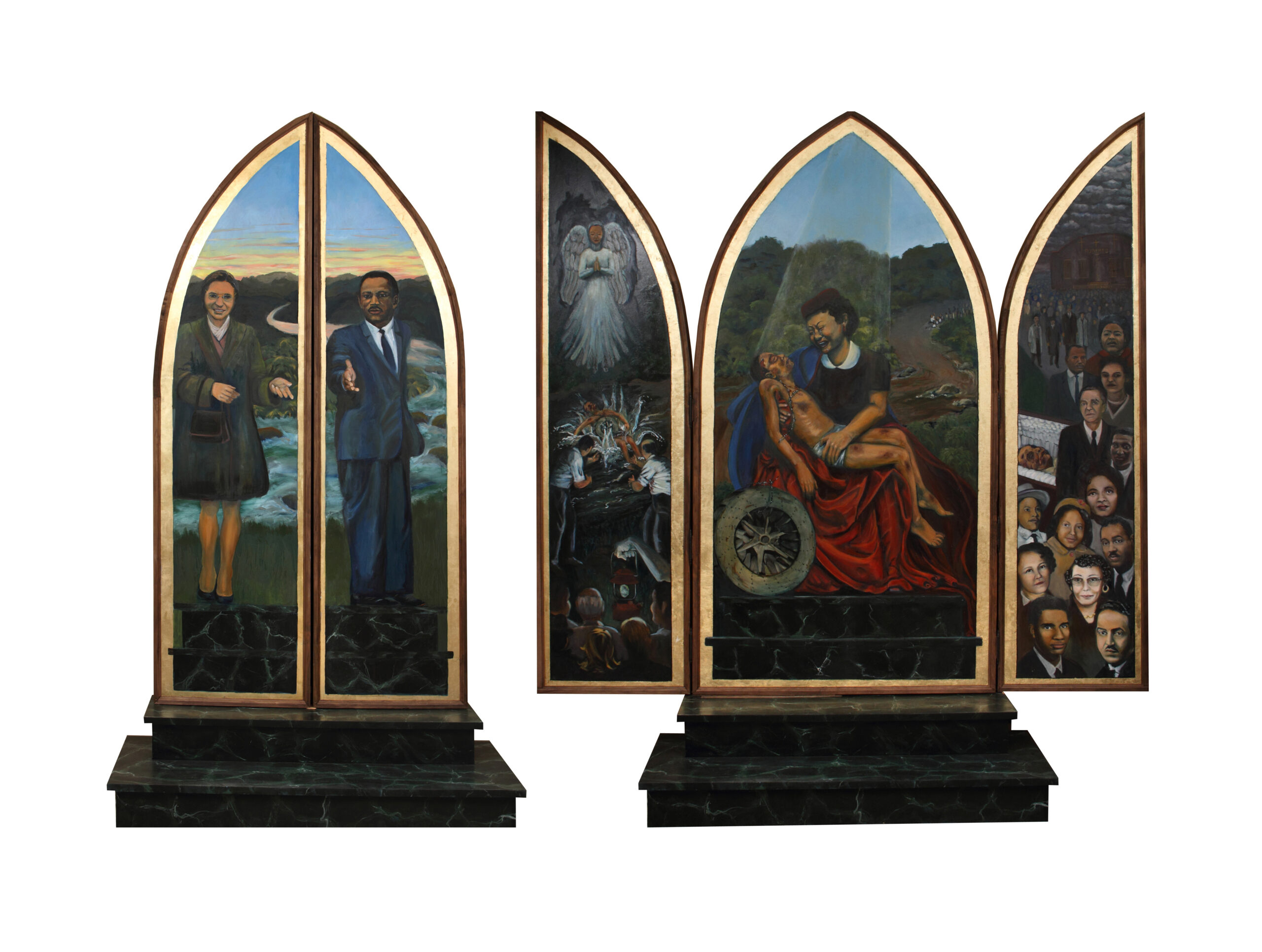
A solemn tribute to memory and justice, The Emmett Till Memorial Triptych weaves reclaimed materials into delicate, light-filtering layers. The textured surfaces hold both fragility and strength, honoring a pivotal moment in American history. This three-panel work transforms discarded medium into a sacred space for remembrance, accountability, and collective healing.
Artist Statement — Sandra R. Hansen
The Emmett Till Memorial Triptych reflects on the life and legacy of Emmett Till, the fourteen‑year‑old African American boy who was tortured and murdered on August 28, 1955, after being accused of whistling at a white woman. His death shocked the nation and became a catalyst for the Civil Rights Movement.
Drawing on the visual language of traditional church altarpieces—crucifixion, mourning, and resurrection—the triptych traces a passage from brutality to grief, and from grief to a rising movement for justice.
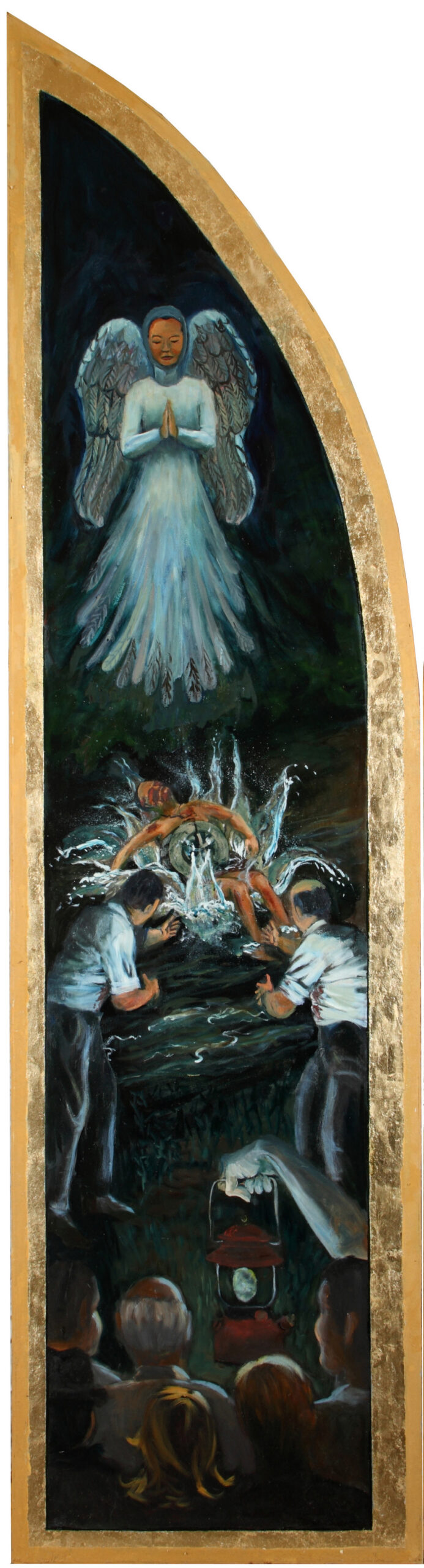
Left Interior Panel — The Crucifixion
The left interior panel depicts the torture and murder of Emmett Till and the moment his body—weighted with a 75‑pound cotton gin fan—is thrown into the Tallahatchie River. The men and women below are the witnesses and possibly the participants in the crime, while the angel above stands as a witness before God.
This panel holds the darkest hour, where violence, complicity, and silence converge.
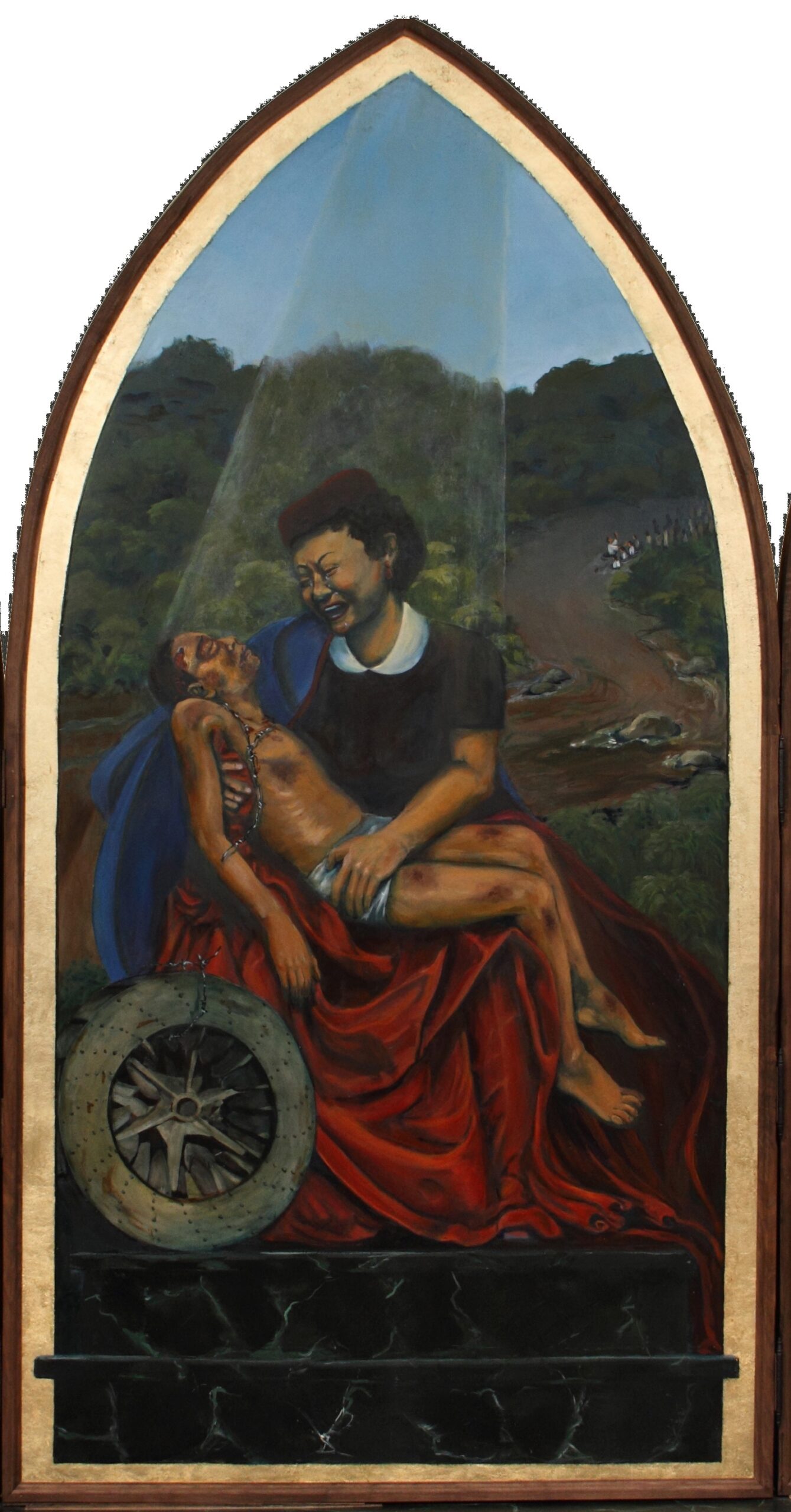
Center Panel — The Pietà and the Catalyst
The central panel echoes Michelangelo’s Pietà, with Mamie Till‑Bradley holding the lifeless body of her son.
Unlike Michelangelo’s Pietà, with its quiet acceptance, Mamie Till‑Bradley’s mouth is open in fury and anguish at the injustice done to her child.
Her insistence on an open‑casket funeral at Roberts Temple Church of God in Christ in Chicago transformed private grief into a public reckoning. When the photograph of Emmett’s disfigured face was published in Jet magazine, the image traveled across the nation and around the world, provoking a wave of grief, anger, and moral awakening that helped ignite the modern Civil Rights Movement.
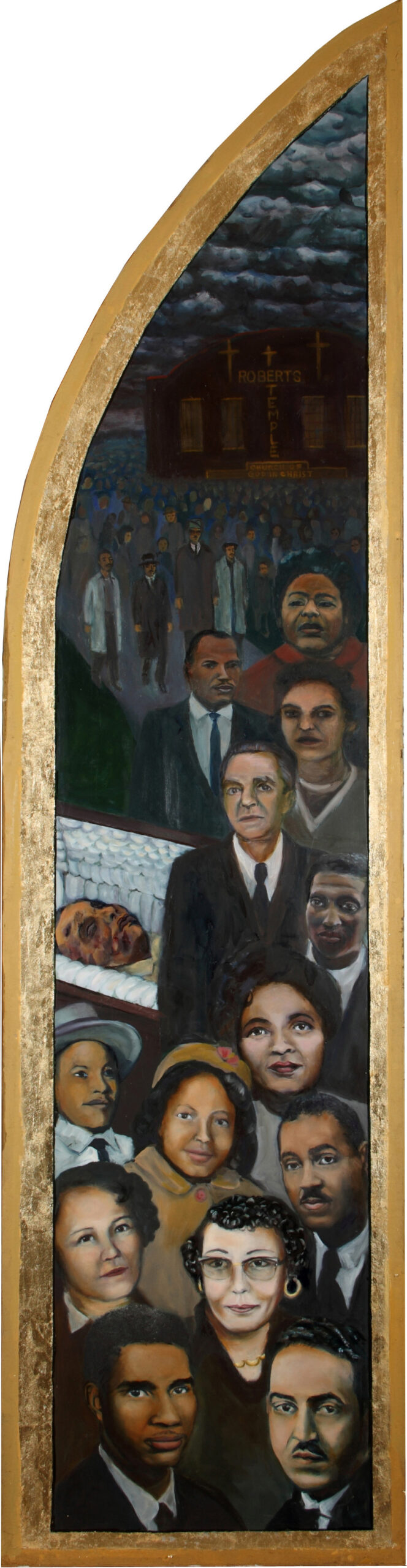
Two images of Emmett appear here: the boy in his coffin, and the boy from a photograph taken the year before—an echo of the life that was stolen.
Right Interior Panel — The Resurrection
The right interior panel represents a symbolic resurrection—a river of people baptized in the Tallahatchie and carried forward into the long struggle for equality. Some were compelled to join the movement by the horror of Emmett’s death; others were already fighting for justice; still others, like the children killed in the 16th Street Baptist Church bombing, were victims of hatred and racism.
At the top right stands Roberts Temple, where thousands filed past Emmett’s open casket. Below it, leaders, organizers, Freedom Riders, and martyrs rise together in a current of collective resolve.
Gathering clouds hang over this panel, reflecting the danger, turmoil, and rising tension of the movement’s early years.
Outer Panels — The Saints and the New Day
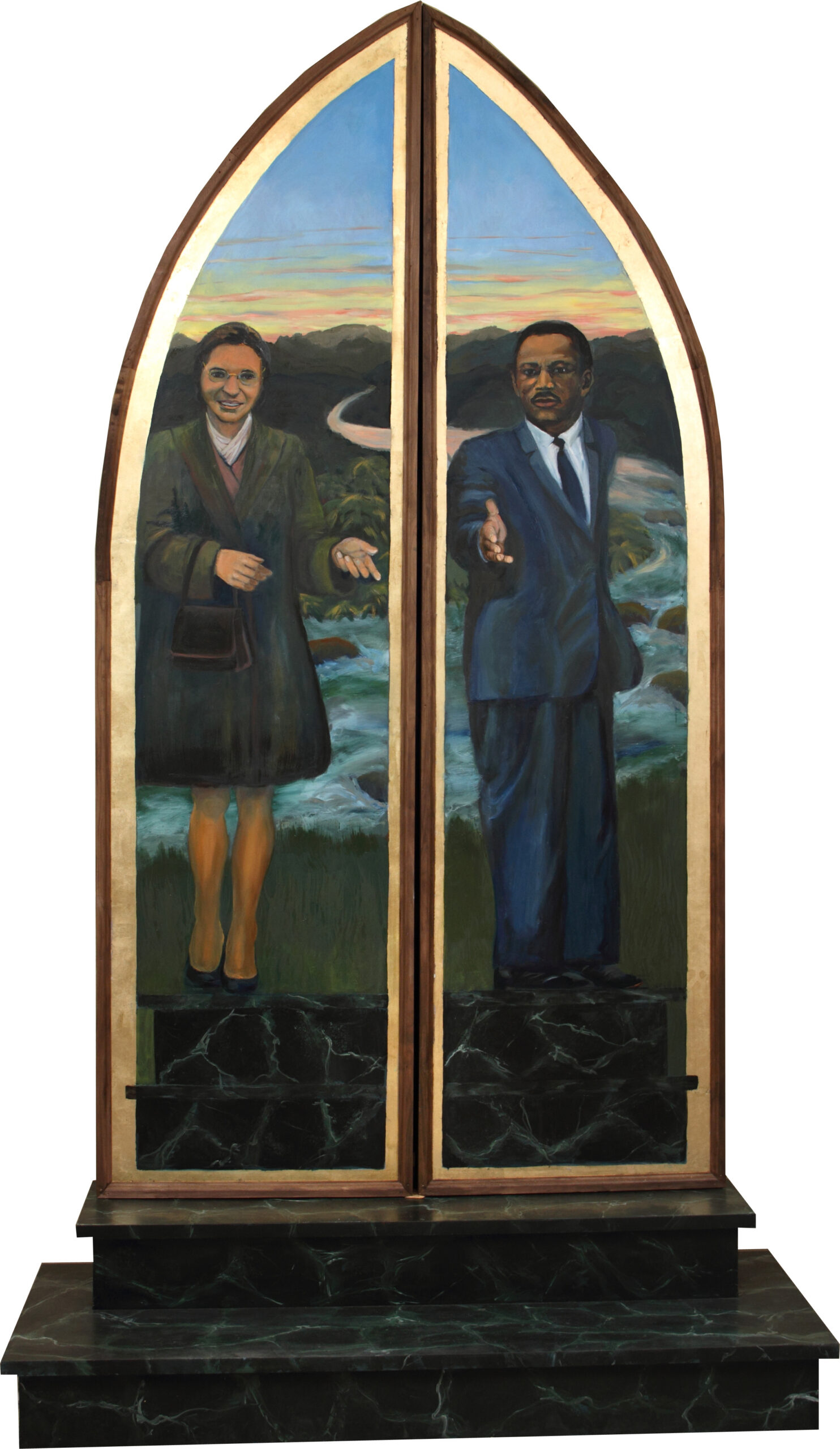
On the outer panels, the Tallahatchie River becomes a clearer, rushing current—a sign of renewal and the movement’s forward momentum. Rosa Parks and Martin Luther King Jr. stand as saints, extending their hands to welcome all who choose to join the work of justice.
Here, the dawning of a new day breaks open, replacing the gathering clouds of the interior. The light does not erase the sorrow—it rises because of it.
Leaders, Witnesses, and Martyrs of the Civil Rights Movement (1954–1964)
- The Greensboro Four appear at the top, representing the young men whose sit‑in at the Woolworth’s lunch counter ignited a wave of nonviolent protests against segregation.
- Fannie Lou Hamer stands as a testament to courage, her work in voting rights helping to dismantle segregation in American politics.
- James Meredith is shown for his determination in integrating the University of Mississippi, an act that forced the nation to confront its resistance to equality.
- Diane Nash appears as the brilliant strategist who organized the Freedom Rides and shaped the movement’s disciplined nonviolence.
- James Peck stands in front, the white Freedom Rider who was beaten nearly to death on the first bus, his injuries becoming a symbol of interracial solidarity and sacrifice.
- Stokely Carmichael stands at the right front, representing the emerging voice of Black empowerment and the leadership of SNCC.
- Emmett Till Appears Twice—once in his coffin and once as the smiling boy from the year before—reminding viewers of both the life lived and the life taken.
- Daisy Gatson Bates stands behind, honored for mentoring the Little Rock Nine as they integrated Central High School in 1957.
- Denise McNair stands in the center, one of the four girls killed in the 1963 bombing of the 16th Street Baptist Church in Birmingham.
- Roy Wilkins appears as the steady, determined leader of the NAACP during some of the movement’s most turbulent years.
- Ruby Hurley stands nearby, representing her work directing the NAACP Youth Council and supporting young activists across the South.
- Jo Ann Robinson appears for her decisive action in launching the Montgomery Bus Boycott immediately after Rosa Parks’s arrest.
- Medgar Evers stands at the left front, honored as an NAACP activist and martyr whose assassination shook the nation.
- Thurgood Marshall appears at the lower right, recognized for arguing Brown v. Board of Education and later becoming the first African American Supreme Court Justice.
No matter where you stand, their eyes follow you — watching to see what you will do with your life.